Why Is Folding Container House the Practical Choice for Fast and Flexible Space Needs?
Businesses today need space that can move faster than traditional construction. From site offices and worker accommodation to emergency housing and remote project support, a Folding Container House offers a more efficient path when time, budget, transport, and ease of installation all matter at once.
Article Summary
This article explains how a Folding Container House helps solve common buyer concerns such as high transport cost, slow installation, uncertain quality, frequent relocation, and limited site conditions. It also breaks down the practical advantages of modular deployment, compares this solution with conventional temporary buildings, and shows what buyers should check before placing an order. Whether you are sourcing for a construction project, mining camp, emergency response program, commercial workspace, or temporary accommodation, this guide gives you a clear view of how to make the right decision.
Table of Contents
Article Outline
- Buyer pain points in temporary or modular building procurement
- Core benefits of a Folding Container House
- Comparison between folding units and conventional site buildings
- Typical application scenarios across industries
- Procurement checklist for product quality and project fit
- Frequently asked questions from international buyers
- How to move from inquiry to project implementation
What Problems Are Buyers Trying to Solve When They Search for a Folding Container House?
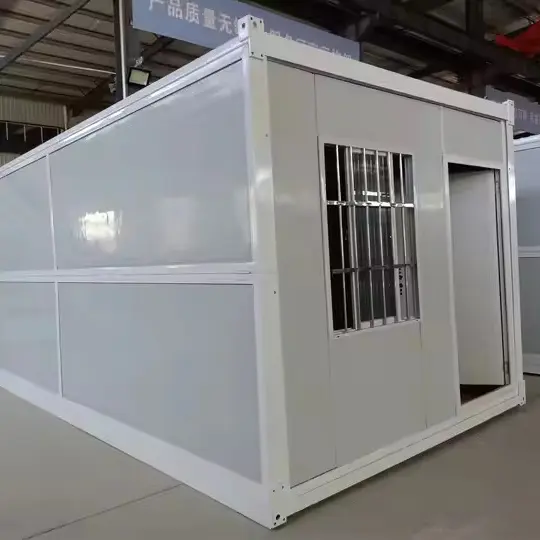
Most buyers are not simply looking for a structure. They are looking for relief from a list of expensive and frustrating problems. In many projects, the real pressure comes from deadlines, logistics, labor availability, and uncertainty at the job site. A traditional building process is often too slow and too rigid for these realities.
The first pain point is time. When a site office, staff room, dormitory, clinic, guard post, or temporary classroom is needed, waiting months for civil construction can delay the entire project. The second pain point is transport efficiency. Bulky modular units can take up too much shipping space, driving up freight costs, especially for export buyers or remote regions. The third pain point is installation complexity. If assembly depends on a large crew or specialized local labor, deployment becomes harder and riskier.
Buyers also worry about repeat use. Many temporary structures are cheap once, but expensive over time because they are hard to relocate, easy to damage, or costly to maintain. Then there is the issue of comfort and safety. A unit may look economical at first, but if insulation, waterproofing, structural stability, or electrical integration are poor, the long-term cost quickly rises.
That is why the market interest in the Folding Container House continues to grow. Buyers want a product that is fast to deploy, easier to transport, dependable in daily use, and flexible enough for changing project conditions.
How Does a Folding Container House Solve These Real-World Challenges?
A Folding Container House is designed around one simple idea: reduce friction at every stage of the project lifecycle. Instead of forcing the customer to choose between speed and reliability, it combines mobility with practical construction performance.
- Faster deployment so the unit can be installed quickly on site and put into use without a long construction cycle.
- More efficient shipping because the folding structure reduces space during transport and improves container loading efficiency.
- Lower site labor dependence since much of the structure is prepared in advance, reducing installation steps.
- Flexible reuse for projects that relocate, expand, or change function over time.
- Cleaner jobsite process with less on-site construction disturbance compared with conventional temporary buildings.
For procurement teams, that means less uncertainty. For contractors, it means faster site readiness. For investors and operators, it means the space begins serving its purpose earlier, whether that purpose is accommodation, administration, sales, storage, or emergency response.
What Benefits Do Buyers Usually Value Most?
- Quick installation that supports urgent project schedules
- Reduced freight burden for export or multi-unit shipment
- Practical mobility for repeated relocation
- Better cost control over the full project cycle
- Adaptability for office, housing, camp, and service use
How Does a Folding Container House Compare with Conventional Temporary Buildings?
Buyers often compare several options before making a decision: site-built temporary rooms, basic prefab sheds, flat-pack units, and folding modular units. The best choice depends on how often the space needs to move, how quickly it must be installed, and how much pressure there is on shipping cost.
| Comparison Point | Folding Container House | Conventional Temporary Building |
|---|---|---|
| Installation speed | Usually much faster due to pre-engineered folding design | Often slower because of more on-site assembly work |
| Transport efficiency | Better shipping utilization when folded | May require more shipping space or fragmented packing |
| Mobility | Suitable for relocation and repeated deployment | Often less convenient to move and reinstall |
| Labor requirement | Reduced on-site complexity | Higher dependence on local labor coordination |
| Project flexibility | Works well for temporary, semi-permanent, and multi-use scenarios | May be limited by design rigidity or assembly burden |
| Lifecycle value | Stronger when reuse is part of the plan | Can become inefficient over multiple relocations |
This is where many buyers start to see the bigger picture. The question is not only “What is the unit price?” but also “How much delay, freight, assembly effort, and future relocation cost does this choice create?” In that broader calculation, a Folding Container House often becomes the more practical answer.
Where Can a Folding Container House Be Used Most Effectively?
One reason this product category has gained traction is that it fits many industries without becoming overly specialized. The same core structure can be configured for different layouts and functions.
- Construction sites for offices, meeting rooms, worker dormitories, canteens, and storage support
- Mining and energy projects for remote camp deployment where transport and speed are critical
- Emergency housing for disaster relief, temporary resettlement, and rapid-response infrastructure
- Commercial use for pop-up offices, sales spaces, display areas, and service points
- Public sector support for clinics, classrooms, sanitation units, and administrative extension spaces
In each of these use cases, the buyer is trying to solve the same business problem: create usable space quickly without accepting the inefficiencies of conventional building methods.
For international buyers, this matters even more. Logistics planning, import timing, labor arrangements, and project sequence all become easier when the structure is designed to move efficiently from factory to site to operation.
What Should You Check Before Buying a Folding Container House?
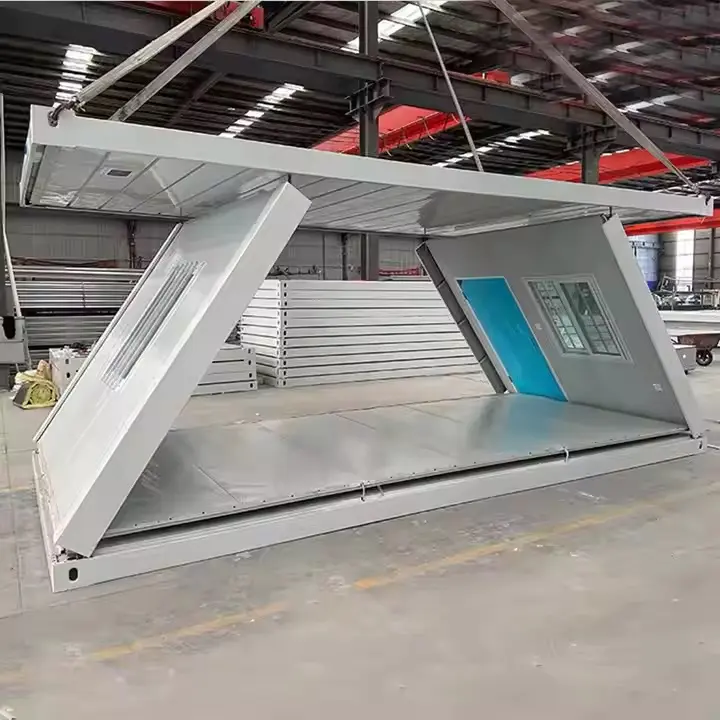
Not every unit on the market delivers the same performance. A serious buyer should evaluate more than appearance and price. The better approach is to assess product readiness, structural reliability, technical support, and application fit.
-
Structure and material quality
Check the frame material, anti-corrosion treatment, panel quality, and expected durability in the target environment. -
Ease of installation
Ask how much work is completed before shipment and what tools or crew size are required on site. -
Transport planning
Confirm loading efficiency, shipping quantity per container, and packaging protection for export. -
Insulation and weather suitability
Review whether the wall and roof system match your temperature, humidity, and wind conditions. -
Electrical and interior options
Clarify wiring preparation, lighting, sockets, doors, windows, flooring, and optional upgrades. -
After-sales support
Make sure installation guidance, technical documents, and response support are available when the units arrive.
A professional manufacturer should be able to explain these details clearly, not vaguely. Buyers do not just need a product. They need confidence that the product will work under real operating conditions.
Why Does the Manufacturer Matter as Much as the Product?
Even a well-designed Folding Container House can become a problem if it comes from a supplier with inconsistent production, weak communication, or limited project understanding. That is why buyers often evaluate the manufacturer and the product together.
Weifang Ante Steel Structure Engineering Co., Ltd. is one of the manufacturers serving buyers who need modular space solutions with practical deployment value. For international customers, what matters most is not only whether a supplier can produce a unit, but whether they can support specification matching, shipment planning, installation coordination, and project communication in a reliable way.
A strong supplier relationship helps avoid common procurement risks such as unclear configurations, mismatched expectations, delayed delivery preparation, and incomplete technical support. When your project depends on fast implementation, these details stop being minor details. They become the difference between a smooth rollout and a costly slowdown.
FAQ
1. Is a Folding Container House suitable for long-term use?
Yes, it can be used beyond short-term projects when the structure, materials, and insulation are selected correctly for the intended environment. Many buyers use these units for semi-permanent operational needs as well as temporary deployment.
2. Can a Folding Container House be relocated after installation?
That is one of its biggest advantages. It is especially valuable for projects that move from one site to another or require phased expansion.
3. Is installation difficult?
Compared with many conventional temporary structures, installation is usually more straightforward because the design reduces on-site assembly steps. The exact process still depends on size, configuration, and local conditions.
4. What industries commonly buy Folding Container House units?
Construction, mining, energy, infrastructure, emergency response, public service projects, and commercial operations are among the most common buyers.
5. What should I ask for before placing an order?
Ask for detailed specifications, layout options, material descriptions, loading information, installation guidance, and after-sales support details. Clear documentation helps prevent costly misunderstandings later.
What Is the Final Takeaway for Buyers Comparing Space Solutions?
If your project depends on speed, transport efficiency, flexible deployment, and practical lifecycle value, a Folding Container House is more than a temporary structure. It is a strategic project tool. It helps reduce delay, simplify logistics, improve relocation potential, and create functional space without dragging the schedule into a conventional building process.
For buyers who are under pressure to move quickly without sacrificing usability, this kind of modular solution makes strong operational sense. The smarter approach is to evaluate not only the product itself, but also the manufacturer’s ability to support your project from inquiry to delivery and beyond.
Ready to Move Your Project Forward?
If you are looking for a dependable Folding Container House solution for accommodation, office, camp, or rapid deployment needs, now is the right time to discuss your project requirements in detail.
Contact us to get tailored product advice, layout recommendations, and a practical solution that fits your timeline, site conditions, and budget goals.