Have you read about the practicality of foldable containers?
Ordinary container homes are based on shipping containers, with insulation layers like rock wool and glass wool added to the inner walls, and fireproof wall panels sealed inside. Due to their large size, each crane can only transport one container home.
Folding container homes, however, can significantly reduce transportation costs. When transporting empty container homes, a single truck can carry several times the original load.
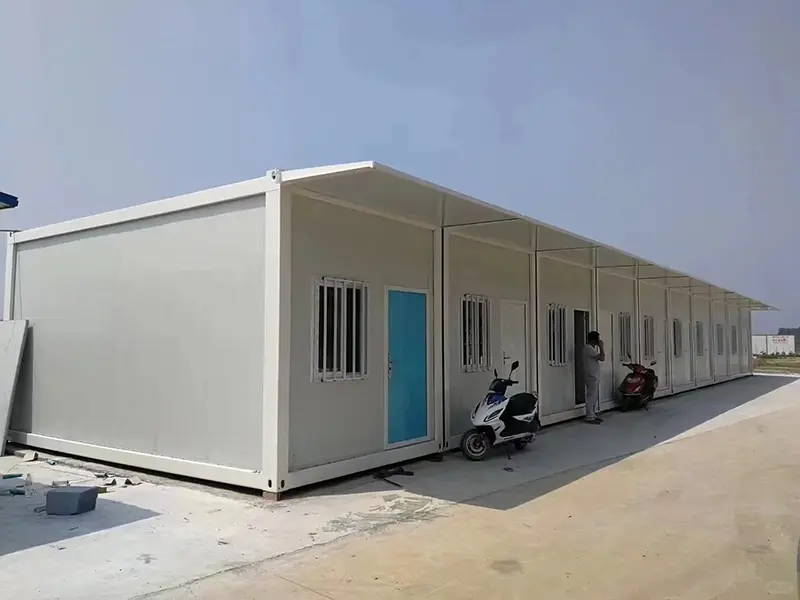
The difference between the two
| Feature | Foldable Container House | Conventional Container House |
|---|---|---|
| Homepage Link | Suitable for stadiums, field hospitals, camping, outdoor activities, construction sites, etc. | Primarily used for logistics transportation, processing and storage, temporary offices, etc. |
| Application Scenarios | Situations requiring quick assembly and disassembly, such as temporary buildings | Scenarios requiring long-term placement and fixation, like warehouses or offices |
| Structural Design | Uses a special foldable design structure, facilitating transportation and storage | Typically has a fixed structure and is not easily foldable |
| Area Occupancy | Occupies less area during transportation and storage | Occupies more area during transportation and storage |
| Transportation Convenience | Easy to transport with high space utilization | Less convenient for transportation with low space utilization |
| Cost | Initial investment may be higher, but long-term usage costs are lower | Initial investment may be lower, but long-term usage costs are higher |
| Earthquake Resistance | Generally has better earthquake resistance | Earthquake resistance is relatively average |
Advantages of Folding Containers
1. Product Features: Sealed, secure, waterproof, windproof, fireproof, corrosion-resistant, cold-proof, shockproof, soundproof, heat-insulating, and recyclable. They effectively improve the comfort and safety of the living environment.
2. Cost Advantages: The folding structure, aluminum alloy frame, and stainless steel hinges ensure durability, ensuring over 10,000 cycles. Furthermore, their ease of use and long-term, high-volume use can significantly reduce operating costs.
3. Transportation Cost: The folding structure allows for up to 20 units to fit on a single truck. Compact transportation facilitates transportation by sea, land, and air.
Installation Process
1. Upon arrival at the project site, first clean the site and ensure it is clear of debris and obstructions to prepare for the installation of the folding container house.
2. Hoist the main frame. Use a crane to lift the main frame and unfold it smoothly. During this process, pay attention to safety to avoid bumping or scratching the folding container house.
3. Place the support rod in the middle of the box. The support rods maintain the stability and strength of the container, preventing it from collapsing or deforming during use.
4. Push one wall open and tighten it with the fastening screws. This process requires screwdrivers, hammers, etc. After tightening the screws, check for a secure fit to ensure the container is stable.
5. Push open the other wall with the doors and windows and tighten the screws. Ensure the doors and windows are positioned correctly and open in the correct direction.